

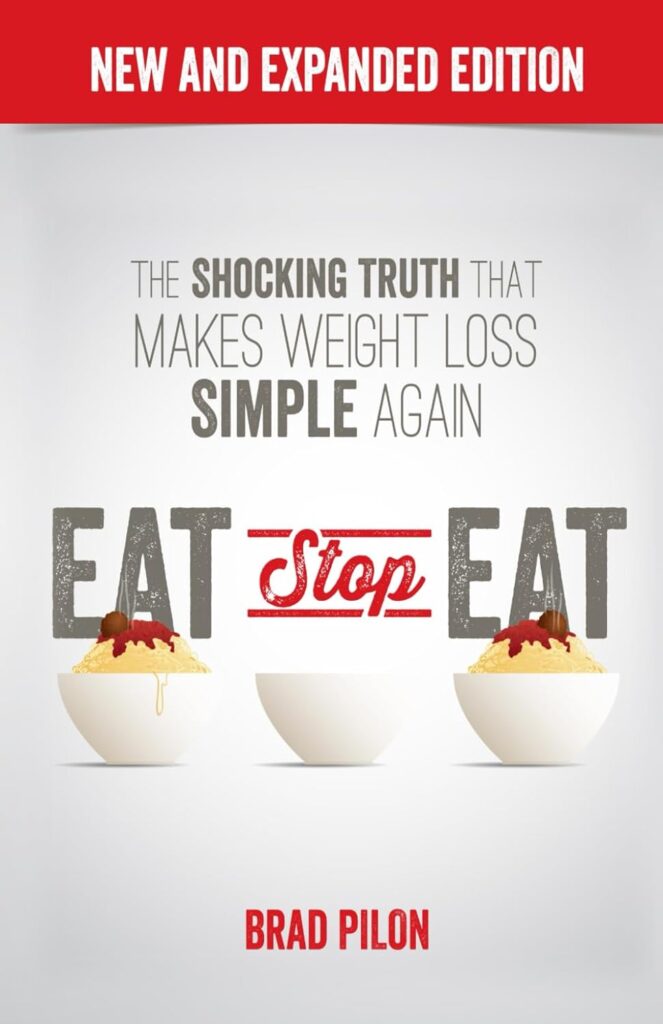
EAT STOP EAT And More Brad Pilon
Free Product
Description
EAT STOP EAT And More Brad Pilon The concept of intermittent fasting has taken the health and wellness world by storm.
Thousands of books have been written about the unique benefits of Intermittent Fasting and its ability to help people lose weight and improve health, but Eat Stop Eat was one of the first.
18 years ago Eat Stop Eat was one of the first books published on Intermittent Fasting — before it became trendy.
➡️➤➤Don’t Miss Out — Click Here To Purchase Official Website
Today it’s in its 6th Edition. And…
Far from being just another fad, Eat Stop Eat has become your indispensable guide to the latest science behind using intermittent fasting for simple, yet effective weight loss, without unneeded complexity or the need to deprive yourself of the foods you love to eat.
Listen, intermittent fasting is not rocket science. You stop eating for a while. You start again.
However the SCIENCE of fasting is very, very fascinating. And you’ll be shocked to learn all the things we know that happen in your body when you fast. (Not to mention what does NOT happen!)
Far from just ‘skipping breakfast’, Eat Stop Eat is a unique approach to intermittent fasting perfect for people concerned about healthy weight loss or those just working on feeling better about their nutrition.
EASY TO FOLLOW – Eat Stop Eat was one of the first books on Intermittent Fasting and offers the fundamentals of an often overlooked approach
CONTAINS SPECIFIC INFORMATION ON FASTING FOR WOMEN – And often confusing aspect of Intermittent Fasting is the unique metabolic needs of women, which are covered in the ‘Fasting for Women’ Chapter of Eat Stop Eat.
SUITABLE FOR ALL DIET TYPES – Eat Stop Eat is extremely flexible version of Intermittent Fasting and can work along side with Vegan, Carnivore, Paleo, Mediterranean or any other diet type.

Eat Stop Eat is everything a person needs to get exactly what they want out of this unique style of Intermittent Fasting.
Early research suggests that periodic, short-term fasting practices could be a simple but effective way to shed unwanted weight and improve metabolic health.
There are multiple ways to add an intermittent fasting protocol to your routine. One method that’s becoming increasingly popular is known as Eat Stop Eat.
This article reviews everything you need to know about the Eat Stop Eat diet, including how to follow it, whether it’s effective for weight loss, and possible drawbacks to consider.
Eat Stop Eat is a unique approach to intermittent fasting that’s characterized by the inclusion of up to 2 nonconsecutive (spaced apart) fasting days per week.
It was developed by Brad Pilon, author of the popular and aptly titled book “Eat Stop Eat.”
Pilon was inspired to write this book after researching the effects of short-term fasting on metabolic health at the University of Guelph in Ontario, Canada (1Trusted Source).
According to Pilon, the Eat Stop Eat method isn’t your typical weight loss diet. Instead, it’s a way to reevaluate what you have been previously taught about meal timing and frequency and how that relates to your health (1Trusted Source).
How it’s done
Implementing the Eat Stop Eat diet is relatively straightforward.
You simply choose 1 day or 2 nonconsecutive days per week during which you abstain from eating for a full 24-hour period. This period of not eating is called fasting.
For the remaining 5–6 days of the week you can eat freely, but it’s recommended that you make balanced food choices and avoid consuming more than your body needs.
Though it seems counterintuitive, you will still eat something on each calendar day of the week when using the Eat Stop Eat method.
For instance, if you’re fasting from 9 a.m. Tuesday until 9 a.m. Wednesday, you’ll make sure to eat a meal prior to 9 a.m. on Tuesday. Your next meal will occur after 9 a.m. on Wednesday. This way, you ensure you’re fasting for a full 24 hours — but not longer.
Keep in mind that even on fasting days of Eat Stop Eat, proper hydration is strongly encouraged.
Drinking plenty of water is the best choice, but you’re also allowed other types of calorie-free beverages, such as unsweetened or artificially sweetened coffee or tea.
Eat Stop Eat is popular among people looking for a simple, straightforward way to lose weight or improve other aspects of health without having to restrict foods or count calories.
Some people like the flexibility that the Eat Stop Eat method affords.
Unlike many other popular diets promoted for weight loss, the Eat Stop Eat method doesn’t require a person to cut out any foods or follow set macronutrient ranges.
The only “rules” of the program are abstaining from eating for a full 24 hours one or two nonconsecutive days per week.
Of course, a person following any dietary pattern should make an effort to consume mostly nutrient-dense, whole foods to support optimal health. However, a special diet isn’t required when following Eat Stop Eat.
At this point, there’s insufficient evidence to determine whether Eat Stop Eat is an effective weight loss method for everyone.
Studies have found various intermittent fasting strategies to be effective for achieving weight loss of up to 9.9% (2Trusted Source).
However, there’s immense variability in study designs, specific fasting protocols, and total weight loss, making it difficult to predict exact results for Eat Stop Eat (2Trusted Source).
Weight loss is a complex process that can be very unique to each individual and many factors beyond calorie intake and meal timing affect your ability to lose or gain weight (15Trusted Source).
Ultimately, more long-term research on Eat Stop Eat is needed to determine whether it’s any more effective than other approaches to weight loss.
➡️➤➤Don’t Miss Out — Click Here To Purchase Official Website
Get more stuff like this
Subscribe to our mailing list and get interesting stuff and updates to your email inbox.
Thank you for subscribing.
Something went wrong.
Related products

Free Product

Free Product

Free Product

Free Product

Free Product

Free Product

Free Product

Free Product
Best selling products
-
 Ancestral Abundance Code
Free Product
-
Divine Wealth Path Reading
Free Product
-
Prosperity Birth Code Reading
Free Product
-
Eva Bloom Soulmate Sketch
Free Product
-
Tara Lunar's Soulmate Sketch
Free Product
-
The Elon Code - Billionaire Brain Neuro
Free Product
-
The Genius Switch
Free Product
-
The Last Wish - Hottest New Manifestation
Free Product
-
Year of the Horse
Free Product
-
Sketch My Lover
Free Product


